
Who is speaking
Who Elena Battaglia is and which Wibo programme she took part in
Elena Battaglia is Talent Acquisition & Employer Branding Specialist at Schneider Electric and took part in the Wibo Leadership Academy. The programme put people from different companies in the same group and combined live sessions with executives, work with a coach, practical exercises and e-learning materials on a platform.
The interview
Our questions to Elena Battaglia, and the answers
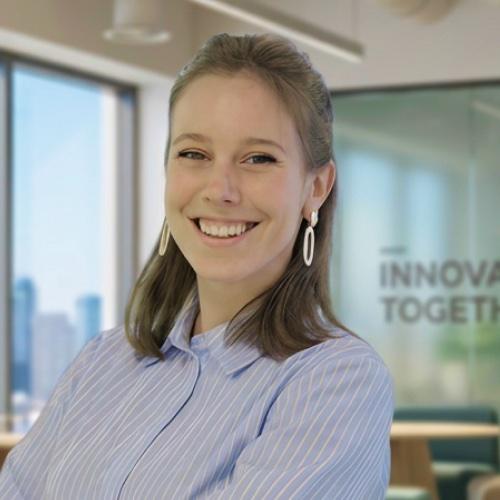 Answered by Elena Battaglia, Talent Acquisition & Employer Branding Specialist, Schneider Electric
How would you describe your experience with the Leadership Academy?
I’d definitely describe this experience as very rich: full of emotions, thoughts and reflections. It was a programme that helped me get to know myself better, and also understand the people around me better. A big added value was working alongside a group of participants from different companies, with different ways of thinking, values and company cultures.
It opens your mind and helps you discover cross-cutting approaches and new points of view, which you can draw useful ideas from and adapt to your own specific context. On top of that, the direct contact with the coach and with the executives who share their experiences is extremely enriching. It gives you a complete, 360° view that doesn’t stay theoretical or abstract, and that you can actually build into your professional path.
It’s an experience that gets you thinking about where you are today and where you want to go. I’d call it a very stimulating programme, full of valuable input and opportunities to grow.
Have you noticed any changes in your approach to work since the Academy? Is there anything that has stuck with you in particular and/or that you have started to apply in your daily work?
Today, in the projects I run and manage, I notice I’m no longer focused only on the result at all costs. I stop, I reflect and I actively involve the people I work with, to make sure we’re aligned on the concrete goals and also on the emotional climate and the meaning we give to what we’re doing. This helps avoid misunderstandings and understand better why, sometimes, a ‘no’ can become a ‘yes’ or vice versa, and how we can work in a complementary way.
I think this is one of the real added values I took home: knowing how to stop, read the context, listen to yourself and listen to others. It’s an approach that has given me plenty of useful ideas, and one I hope to put into practice more and more.
Of course, in the daily rush it isn’t always easy, but just being aware of it and having started to practise is a big step forward.
Wibo si differenzia per la continuità e la coerenza del percorso formativo: le diverse sessioni non sono scollegate tra loro, ma fanno parte di un viaggio strutturato
[Wibo stands out for the continuity and consistency of the programme: the sessions aren’t disconnected from one another, they’re part of a structured journey]
Elena Battaglia, Talent Acquisition & Employer Branding Specialist, Schneider ElectricIf you think about other programmes you have taken, how is Wibo different from the others?
In my view Wibo stands out for the continuity and consistency of the programme: the sessions aren’t disconnected from one another, they’re part of a structured journey. Even though each session covers a different topic and approach, you feel you’re building something step by step. I often caught myself thinking: ‘OK, we already touched on this idea from another angle in the previous session, and now I’m adding a new piece.’ This helps create an experience that is rich, varied and truly complete.
Another distinctive aspect is that it isn’t just about listening passively: the sessions aren’t simple lectures. There’s a real dialogue with the executives, who are there to share their vision and also to listen and engage with us. I really appreciated this two-way exchange. In particular, I found the work we did afterwards with the coach very valuable. She managed to spark new questions and reflections, mixing ideas that came from us with others she brought in at the right moment and in the right context.
This enriched the experience even further. Finally, I think it really makes a difference that it isn’t a purely theoretical programme: the exercises and practical activities help you internalise the content and come back to it later on. They don’t stay abstract concepts: they become concrete tools you can carry with you over time.
If you think about the sessions held, which aspects were most useful or involved you the most?
My feedback on the programme is definitely positive, for every session. Of course there are executives you feel more in tune with, whose communication style you appreciate more, but I think this also reflects the dynamics we then face every day inside our organisations. In fact, hearing voices different from your own is one of the most valuable parts: it pushes you to reflect on things you may never have considered, and lets you try yourself out in a safe learning environment.
In a setting like Wibo’s you can afford to make mistakes, ask awkward questions or explore topics that, at your own company, you might feel less free to raise because of your reputation or your role. Putting yourself on the line is really the key to getting the most out of this experience. Another thing I really appreciated is the e-learning part on the platform. It’s a really useful support because it lets you go deeper into the content outside the live sessions too. That way, you don’t just have that half day set aside for training: you can pick up the materials whenever you want, calmly, at a moment when you’re really ready to reflect. You can also prepare better for the following sessions.
In the end, it almost surprises you that you look forward to these lessons: it isn’t like going back to school, it’s a moment you genuinely look forward to, knowing you’ll find people you can talk to openly and learn from.